
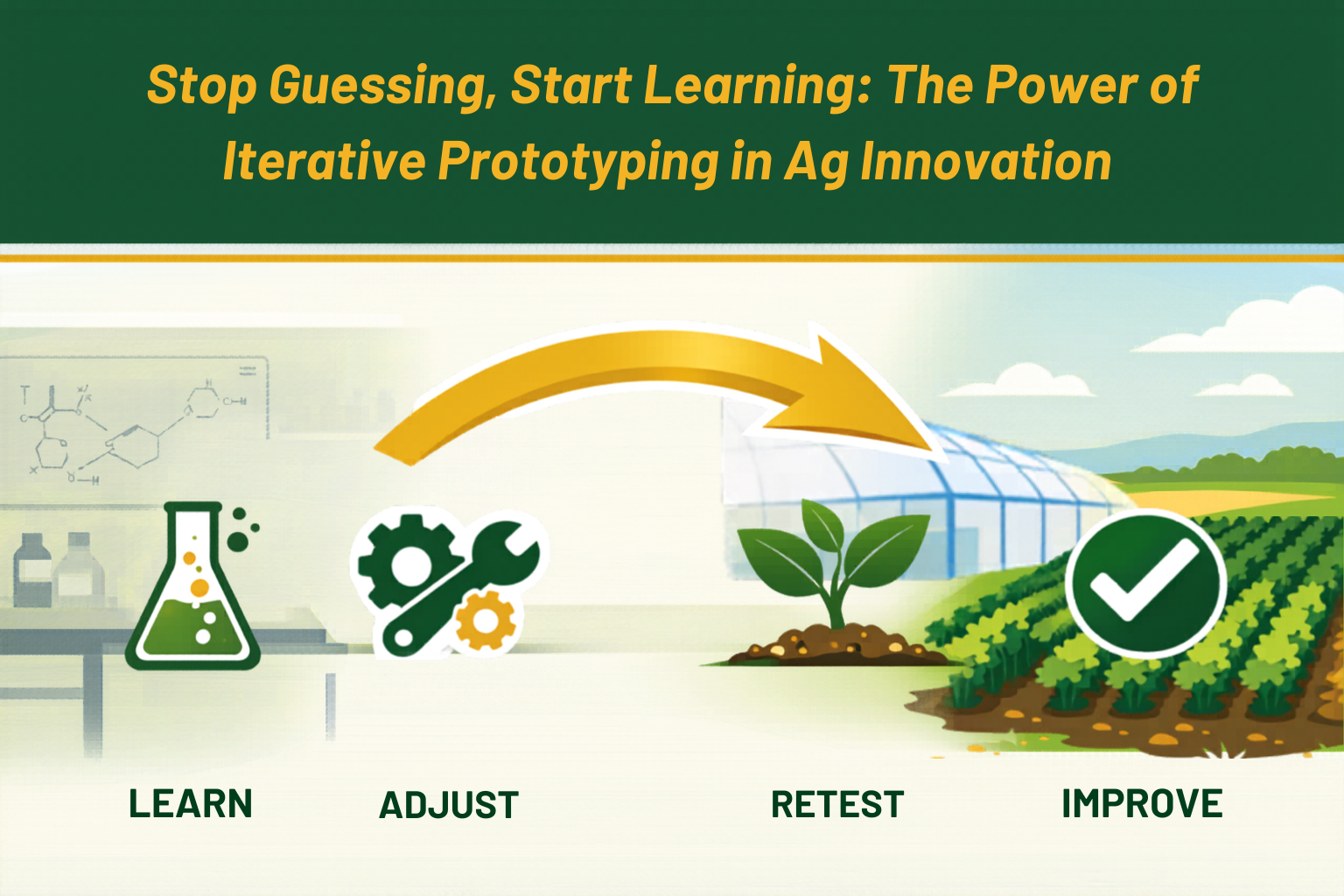
This post is the first in a two-part series examining how modern agricultural products are built. Part 1 explains why iterative formulation prototyping is the scientific backbone of successful development. Part 2 will show how AgX applies this framework in practice to deliver robust, field ready formulations with speed and rigor.
Why Prototyping Matters in Product Development
Agricultural product development is inherently risky. Ag innovators operate within narrow seasonal windows, unpredictable environmental conditions, and biological systems that rarely behave the same way twice. If something goes wrong, you don’t just lose time, you can lose an entire season. Yet many development teams still jump too quickly into field trials or rely on assumptions that haven’t been tested.
Iterative formulation prototyping is the most reliable way to reduce that risk. It brings structure, evidence, and speed to a process that otherwise leans heavily on guesswork. When done well, prototyping becomes the engine that drives clarity, accelerates timelines, and avoids expensive surprises later in the development.
What a Prototype Actually Is
In formulation development, a prototype is not a rough draft of the final product. It is a purpose-built experimental formulation designed to answer a specific question. Each prototype isolates variables, formulation type, ratios, coformulants, processing conditions, so teams can understand how each factor influences performance.
This distinction matters because some misconceptions still persist:
- “Prototypes are unnecessary; we’ll finalize the formulation later.” In reality, skipping early prototypes almost guarantees costly rework later.
- “Greenhouse results aren’t predictive.” While not a substitute for field trials, controlled biological testing provides essential early signals.
- “We can test everything at once.” When too many variables move together, teams can’t identify what actually drives performance.
Prototypes are controlled test vehicles. They are designed to generate insight. Prototypes are not meant to be perfect, not intended to be final formulations, and often not scalable. Their value lies in what they reveal.
The Formulation Design Analysis: Setting the Stage
Before a single prototype is made, teams must define the viable formulation space. This is where a disciplined formulation design analysis becomes essential. It clarifies what is possible, what is practical, and what is worth testing.
A strong design analysis considers:
- Chemistry and physical property constraints
- Target use patterns and application methods
- Compatibility expectations with tank mixes and water qualities
- Regulatory requirements and documentation implications
- Market expectations, cost targets, and competitive products
This upfront work prevents wasted cycles. Instead of exploring every theoretical option, teams focus on the formulation paths that are both feasible and strategically aligned. It is the difference between wandering and navigating.
Building Small, Controlled Prototypes
Effective prototyping relies on small, intentionally controlled batches. These early formulations are not meant to be polished. They are meant to teach as much as possible from each iteration.
Variables explored may include:
- Formulation type (EC, SC, SL, WG, etc.)
- Active ingredient ratios and synergistic interactions
- Coformulant screening and functional role evaluation
- Surfactant and emulsifier systems
- Processing parameters such as shear, temperature, and order of addition
Each prototype is built around a hypothesis: If we adjust this variable, what happens to stability, usability, or biological performance?
This approach ensures that every experiment has a purpose, and every result has a meaning.
Rapid Testing Cycles: Generating Actionable Data
Once prototypes are created, rapid testing cycles provide the data needed to guide decisions. Physical property testing offers early insight into formulation robustness:
- Chemical and physical stability under accelerated storage conditions
- Dilution behavior and tank mix compatibility
- Viscosity, pH, particle size, or emulsion quality
These tests reveal weaknesses long before they become field failures.
Biological testing, most often conducted in greenhouses or growth chambers, adds another layer of insight:
- Early efficacy trends
- Phytotoxicity risks
- Dose response behavior
While not definitive, these controlled studies help teams identify promising directions and prioritizing what should move forward. Clear evaluation criteria ensure that prototypes are judged consistently and objectively.
The Iterative Feedback Loop
Iteration is the core engine of successful formulation development. The cycle is simple but powerful:
Learn → Adjust → Retest → Improve
Each cycle narrows the formulation space. Weak options fall away early. Strong candidates become more refined with each iteration. Uncertainty shrinks. Confidence grows.
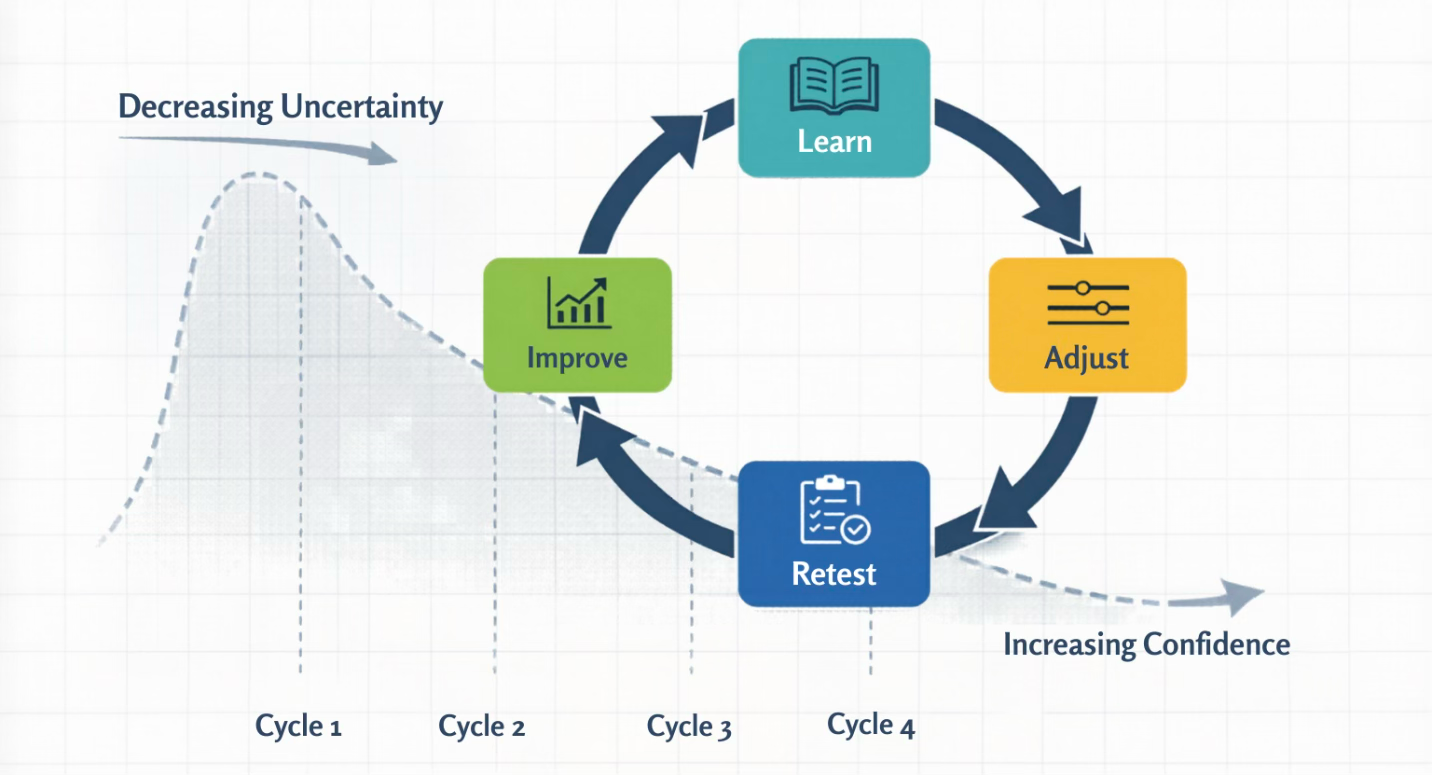
This iterative loop replaces assumptions with evidence. It ensures that by the time a formulation reaches field trials, it is not a guess—it is a refined, validated, and resilient candidate with a high probability of success.
The Cost of Skipping Prototyping
When teams skip or minimize prototyping, the consequences tend to show up later, and they are usually expensive:
- Field failures can cost an entire season or even worse multiple seasons.
- Trial programs become more inefficient when unstable or underperforming formulations enter the pipeline.
- Timelines slip when issues surface late in development.
- Reputational risk increases when products fail to meet expectations.
Prototyping is the cheapest place to fail and the most valuable place to learn. Every hour invested upstream saves weeks or months downstream.
Conclusion
Prototyping is not an optional step in agricultural product development. It is the foundation of a disciplined, evidence driven process that reduces risk, accelerates progress, and increases the likelihood of commercial success.